
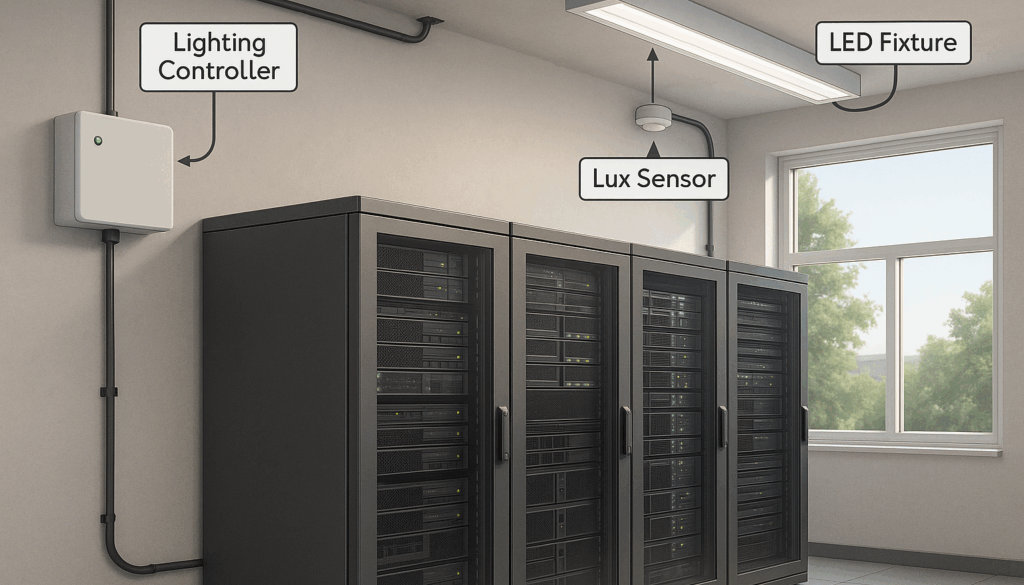
Daylight Harvesting in Data Centers: The Ultimate Guide to Smart Lighting, Energy Efficiency & Sustainable Infrastructure
Table of Contents
- What Is Daylight Harvesting, and Why Should Data Centers Care?
- Core Components of a Daylight Harvesting System
- Designing Light Zones Inside a Server Facility
- Performance Gains and Energy Reductions
- Integration with Smart Lighting and BMS
- Challenges and Missteps to Avoid
- Regulatory Compliance and Green Certifications
- Real Deployments and Lessons Learned
- FAQ
Key Takeaways
- Daylight harvesting can reduce lighting energy usage by up to 60% in server facilities.
- It requires proper daylight zoning, compatible LED fixtures, and sensor calibration.
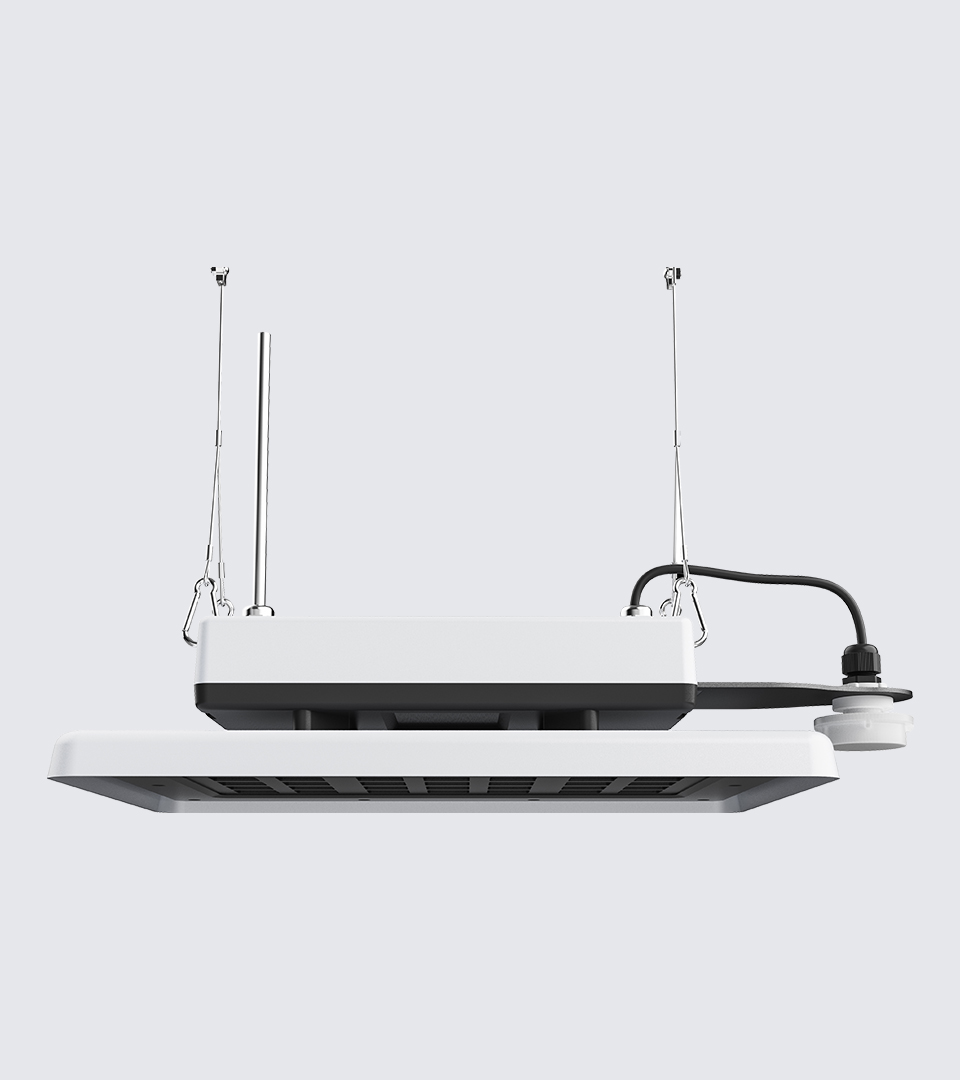
- Squarebeam Elite and Quattro Triproof Batten are suitable for integration with daylight sensors.
- Design must factor in heat load, sensor coverage, and lighting distribution zones.
- Used correctly, daylight harvesting aids compliance with LEED, Title 24, and more.
1. What Is Daylight Harvesting, and Why Should Data Centers Care?
Daylight harvesting isn’t new. But in server environments, where uptime and thermal balance are king, the idea still feels radical. In basic terms, daylight harvesting uses natural light to reduce reliance on artificial lighting. Sensors measure available sunlight and dim or switch off LEDs when it’s bright enough — simple in theory, trickier in execution.
In facilities with controlled internal climates and tight tolerances, like a server hall, it raises a key question: does it compromise environmental consistency?
Short answer: No. If designed properly, daylight harvesting can work with climate and uptime constraints, not against them.
2. Core Components of a Daylight Harvesting System
To implement a reliable system, you’ll need more than just sensors. The setup typically includes:
- Photocell Sensors (open- or closed-loop)
- Dimmer Drivers or Smart DALI Interfaces
- Compatible Fixtures (low flicker, fast-dimming response)
- Control Logic (BMS integration or standalone controllers)
| Component | Function |
|---|---|
| Open-Loop Sensor | Measures natural light only, for window-facing zones |
| Closed-Loop Sensor | Measures total light (sun + LED), for dynamic control |
| Dimming Driver | Adjusts output of LED luminaires based on signal |
| BMS Integration | Connects lighting to the central automation system |
3. Designing Light Zones Inside a Server Facility
Most data centers aren’t bathed in skylight. But you don’t need a greenhouse to benefit. Here’s how we break it down:
- Primary Zone: Directly adjacent to windows or skylights
- Secondary Zone: Further from openings, receives reflected or indirect light

4. Performance Gains and Energy Reductions
Field data shows daylight harvesting can yield 20–60% energy savings in lighting costs — depending on your latitude, layout, and glazing quality.
| Area | Before (kWh/mo) | After (kWh/mo) | % Savings |
|---|---|---|---|
| Server Corridor | 920 | 540 | 41% |
| Admin Workspace | 1100 | 640 | 42% |
| Storage / Cable Runs | 750 | 390 | 48% |
5. Integration with Smart Lighting and BMS
Systems like DALI-2, KNX, and BACnet make real-time daylight response practical. What matters most:
- Latency: Fast dimming response
- Granularity: Per-fixture control preferred
- Feedback Loops: Calibration data must be cycled back to the system
6. Challenges and Missteps to Avoid
- Wrong sensor placement (too close to HVAC)
- Improper sensor type (open-loop vs closed-loop)
- No override settings — leads to operational friction
7. Regulatory Compliance and Green Certifications
- California Title 24: Requires daylighting in most commercial areas
- LEED v4.1: Can earn interior lighting points
- BREEAM / GBI: Recognize automated daylight zone controls
8. Real Deployments and Lessons Learned
Example: In a facility near Kuala Lumpur, 36 units of Squarebeam Elite were used in daylight-capable access corridors. Energy usage dropped 43% with no staff complaints post-installation.
FAQ
- Q1: Can daylight harvesting be used in enclosed server halls?
A: Not effectively — best for corridors and office zones with window access. - Q2: Does it interfere with HVAC systems?
A: No, if designed and placed correctly, it supports thermal balance. - Q3: Which sensor type is best?
A: Closed-loop for enclosed areas, open-loop for external zones. - Q4: Can it work with motion sensors?
A: Yes, and it’s often more efficient to pair them. - Q5: What’s the typical ROI?
A: 1.5 to 3 years depending on utility cost and scale.