
Best Data Center Aisle Lighting: How to Choose Fixtures and Plan the Layout
- Set visibility goals for the floor and rack faces
- Match fixture type and optics to aisle geometry
- Align the layout with rack rows and containment
- Use efficient lighting and controls without compromising visibility
- Plan retrofits for real facility conditions
- Include emergency lighting and safe egress in the plan
- Frequently Asked Questions
- Conclusion
Hey there, planning data center aisle lighting is about more than making the floor look bright. We want technicians to see their work clearly, identify equipment quickly, and move safely while the lighting works with the facility’s controls and operating conditions.
Key Takeaways
| What to plan | Why it matters |
|---|---|
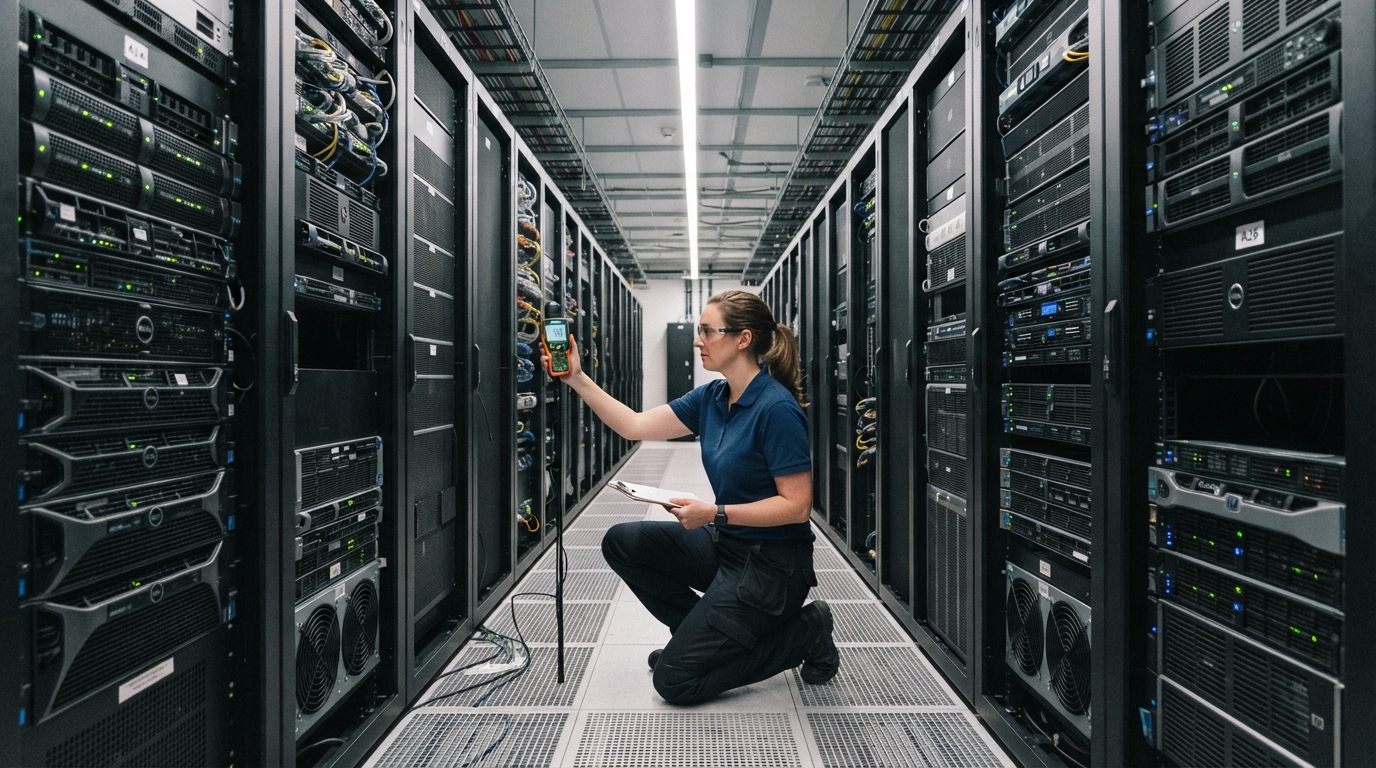
| Measure the floor and rack faces separately. Our server-room lux measurement guide explains how to assess both. | Technicians need useful light on the walking and work area, plus clear visibility of labels, ports, and equipment. |
| Set maintained illuminance by task. Use facility requirements and applicable standards; the data center lighting standards guide outlines practical zone targets. | Routine checks and detailed maintenance do not always need the same lighting conditions. |
| Match the fixture to the space. The fixture-selection guide covers Squarebeam Elite, SeamLine Batten, Budget High Bay Light, and Quattro Triproof Batten. | Linear, high-bay, and protective fixture designs solve different aisle and nearby-area needs. |
| Align the layout with rack rows. | Purposeful fixture runs and suitable optics help avoid dark patches on rack faces. |
| Zone controls around real use. | Occupancy sensors can reduce output in quiet zones while keeping work areas ready for technicians. |
| Plan emergency operation independently. | Required routes need usable light when normal power or controls fail. |
Set visibility goals for the floor and rack faces
Start by deciding what the light must make visible. Horizontal illuminance describes light on the aisle floor or a horizontal work plane, while vertical illuminance describes light reaching the front of the racks, where staff read labels, inspect ports, and identify equipment.
Choose maintained illuminance for the actual task, not from a general impression of brightness. Routine checks, equipment identification, and detailed maintenance can call for different targets, so use applicable standards and facility requirements to set the right level for each zone.
For a practical starting point, published data center guidance gives a range of about 300–500 lux for server and equipment aisles, with final targets set by the task and project requirements. Record readings at representative points along the aisle and across rack faces, rather than judging the whole installation from one bright spot.
Continuous-row lighting can suit corridors and raised-floor retrofit work where evenly distributed brightness is useful. CAE SeamLine is identified as an option for those applications, making it a relevant fixture to consider when the project needs consistent corridor coverage.
A useful measurement record includes the room and rack layout, the measurement locations, the luminaires in operation, and the control state during testing. We strongly encourage teams to compare average and minimum readings, because a strong average can hide dim sections that make a label or port difficult to see.
Match fixture type and optics to aisle geometry
For a narrow server aisle, consider an LED linear fixture running parallel to the rack rows. Its continuous distribution can reduce dark gaps compared with a general ceiling-grid layout that ignores the aisle geometry.
A photometric plan using the actual mounting height and rack layout shows uneven coverage before installation begins.
| Fixture type | Where it can fit | What to evaluate |
|---|---|---|
| Linear batten | Narrow aisles and long rack rows | Continuous coverage, rack-face light, aisle-edge uniformity |
| Panel light | Broader ceiling areas | Distribution at racks as well as floor coverage |
| High-bay fixture | Open or higher-ceiling areas | Beam spread, mounting height, and whether the aisle receives useful light |
| Protective or vapor-tight construction | Dusty or moisture-prone spaces | Environmental conditions, airflow, and mounting requirements |
The SeamLine Batten suits continuous aisle lighting and long runs. That linear form makes it a sensible option to compare for long rack runs where consistent aisle coverage matters.
A high-bay fixture belongs in the comparison for more open spaces, such as maintenance and loading bays, equipment bays, or storage mezzanines that need stronger general-area lighting. Budget High Bay Light is described for those areas, including equipment and storage spaces requiring more than 300 lux; a broad beam still needs to suit the actual aisle width and ceiling conditions.
For a closer look at linear fixture selection and mounting considerations, see our guide to choosing a hanging linear light for a data center.
Align the layout with rack rows and containment
Run fixtures along the rack rows and aisle direction instead of relying on a generic ceiling grid. Consistent spacing and an aisle optic suited to the mounting position help maintain useful rack-face illumination from one end of the aisle to the other.
In the photometric review, account for rack height, aisle width, fixture optics, mounting position, overhead obstructions, and likely shadows. Check light at floor level and at representative rack-face locations, since a layout that looks even from above can still leave labels or equipment fronts in shade.
Glare matters too. Review reflections on rack surfaces, status indicators, and camera views, then select and aim optics to keep the light useful without harsh reflections that distract technicians or obscure what a camera sees.
Use efficient lighting and controls without compromising visibility
Compare LED fixtures by useful light output and distribution, not efficacy alone. A high lm/W figure cannot tell you whether the rack faces, aisle ends, and work locations receive enough light.
The SeamLine LED Batten is an integrated, lightweight fixture for data center infrastructure, with anodized aluminum and polycarbonate construction. Its listed specifications include 150–160 lm/W, a CRI above 90, and a 140° beam angle, details that help teams compare efficiency, color rendering, and distribution in the context of their layout.
Zone occupancy sensors around how people use the space. An aisle used for frequent checks needs a different control response from a storage zone visited occasionally, and scheduled or reduced output should never leave an active work area poorly lit.
Set sensor coverage, timeout behavior, and schedules to suit the rack layout, then test them during work conditions. Unexpected switching or a timeout that dims lights while a technician is working creates disruption, so include real occupancy and maintenance scenarios in the commissioning checks.
Lighting power and fixture heat also belong in the facility efficiency conversation. The International Energy Agency notes that the share of cooling systems in total data centre consumption varies by data centre type, which is a useful reminder to consider lighting power as part of the room’s overall cooling plan while keeping visibility and safe operation first.
Cooling accounts for about 7% in efficient hyperscale data centres and over 30% in less-efficient enterprise data centres.
Source: International Energy Agency
Quality is the cornerstone of our philosophy, and efficient lighting only helps when it serves the task. If your BMS allows it, connect lighting controls with the building’s operating strategy so the zones, schedules, and maintenance modes work together.
Plan retrofits for real facility conditions
Before replacing fixtures, map mounting points, ceiling services, control compatibility, and emergency-power requirements. Plan the work sequence around active operations and keep safe access to racks and equipment clear while installers work.
Dust, moisture, and airflow conditions should guide fixture construction and position, not appearance alone. For spaces exposed to dust or airflow-control issues, Quattro Triproof Batten is identified for ceiling mounting and raised-floor retrofit use, making it a relevant option for demanding retrofit conditions.
If racks or containment may move, review the lighting layout against the revised geometry before the change becomes permanent. New aisle widths and rack positions can alter fixture spacing, shadows, sensor coverage, and rack-face illumination.
During commissioning, measure both floor and rack-face light, inspect for glare and shadows, test sensor coverage and timeout behavior, and verify emergency-light operation.
Include emergency lighting and safe egress in the plan
Plan emergency lighting and backup power for required routes and tasks separately from normal occupancy-control behavior. The normal sensor schedule must not determine whether an egress route remains usable when regular power or controls fail.
Test emergency operation during commissioning and include it in ongoing facility procedures. Check that light reaches the route people must use and that racks, containment, or equipment access do not create avoidable obstructions.
Coordinate aisle lighting with routes beyond the server hall, including paths from service entrances, parking areas, and secure doors. Those areas need their own layout and camera-aware aiming rather than an extension of the rack-aisle grid.
For additional planning context, read our guides to emergency lighting in data centers and lighting compliance and facility standards. Together, these checks keep normal visibility, backup operation, and safe egress in the same project conversation.
Frequently Asked Questions
What color temperature is commonly used in server rooms?
A neutral-white range of 4000–5000 K is commonly used for technical spaces. Keeping the color temperature consistent across connected aisles helps avoid abrupt changes in appearance as technicians move through the room.
Does high-CRI lighting make equipment labels easier to read?
High-CRI lighting renders colors more faithfully, which helps when technicians distinguish color-coded cables and indicators. It does not make small text sharper, so label readability still depends on adequate illumination, contrast, and viewing angle.
What can cause LED lights to flicker in a data center aisle?
Common causes include a failing LED driver, loose wiring, unstable supply, or a dimmer that does not match the fixture. Flicker that begins after a controls change is a useful clue to check driver-control compatibility as part of fault finding.
How often should data center aisle lights be inspected and cleaned?
Include a visual check during routine facility rounds and a documented inspection during planned preventive maintenance. Clean lenses when dust or residue is visible, and record any damaged diffusers, loose fittings, or changes in light output.
Can a data center use wireless controls for an aisle-lighting retrofit?
Yes, wireless mesh controls can suit retrofit zones where adding control cabling is disruptive. Plan signal coverage and test sensor response throughout the aisle so the control system operates consistently behind racks and containment.
Why do data centers have lights?
Data centers have lights so technicians can safely navigate the facility, identify equipment, and read labels or inspect ports while working. Lighting also supports safe access and egress, including when normal power or controls fail.
Conclusion
Good data center aisle lighting starts with clear visibility targets for both the floor and rack faces, then matches fixture type, optics, spacing, and controls to the real aisle geometry. We strongly encourage facility teams to review shadows, glare, containment, retrofit conditions, and emergency operation as one coordinated plan.
It’s not just about choosing an LED fixture; it’s about giving technicians dependable visibility without wasting light where it is not needed. So, come on board with us and together, let’s brighten the future bit by bit.
Request a Data Center Aisle Lighting Plan & Quote
Send us your floor plan or rack layout. CAE Lighting can help you select suitable LED fixtures, plan their placement, and review motion-sensor and emergency-lighting options.
Tell us about your project:
- Project location
- Rack layout, aisle width and mounting height
- Required lighting levels, if specified
- Motion-sensor or emergency-backup requirements
- Estimated quantity and installation timeline
No complete drawings yet? Share your room dimensions and a few site photos to start the discussion.